From diagnosed conditions to what the app actually does
Scholexis is student-owned academic support for high-school and college students with diagnosed ADHD, autism, or learning disabilities. It starts with what those conditions actually do to schoolwork, then changes the application because of that understanding.
The product map connects 24 conditions to 76 distinct application functions, and tracks each one as built, partial, unbuilt, or still unverified. This is not a generic planner with an “ADHD mode.” The condition supplies the reason; the application behavior is the response; the running-product audit keeps the claim honest.
What that means in practice
Task hesitancy: Starting can cost more than doing. The most overdue item may be the least startable precisely because it has become so loaded. So Scholexis ranks for startability before urgency and can make the first action almost embarrassingly small.
Time blindness: This is not merely forgetting dates; it is difficulty estimating and experiencing duration. So work appears as a proportional shape, and future estimates quietly adjust from actual-versus-estimated time.
Interruption cost: An interruption may end the work rather than pause it. So the application preserves where the student stopped, what was happening, and what comes next.
Asking is the hard part: The social judgment and language of a request may cost more than the underlying need. So Scholexis helps draft extension or accessibility language the student controls and sends. Scholexis never sends it.
Scholexis does not diagnose and is not an alternative to assessment, accommodations, coaching, counseling, teaching, or treatment. It makes known conditions operational inside the academic tools a student uses between those forms of support.
More conditions, different application behavior
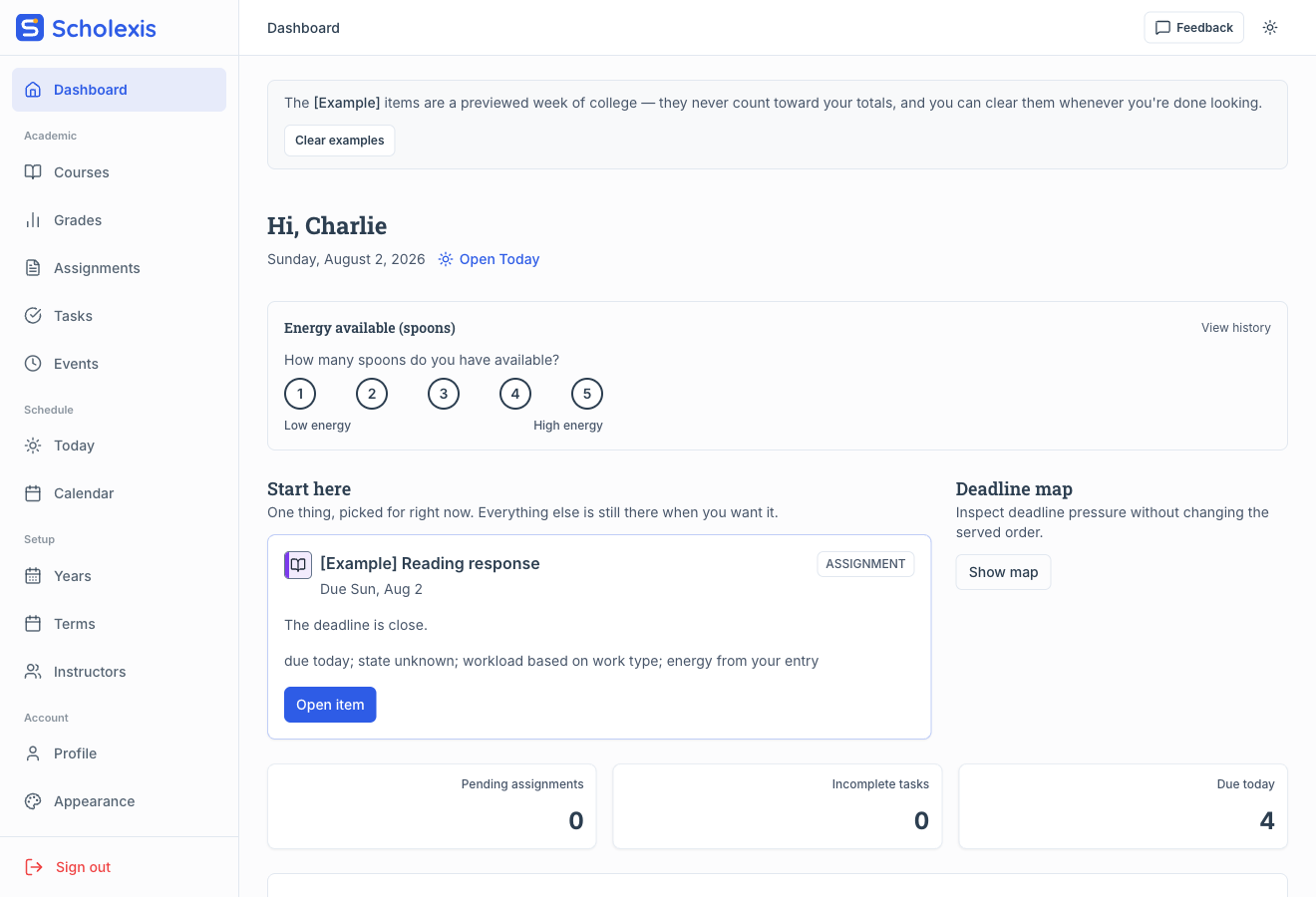
Limited energy changes how work is priced and what fits today. Demand avoidance changes reminder language from commands to observations and provides one switch that stops all suggesting. Masking changes permissions: supporters may see plans, never the student's private state, and nothing leaves without the student choosing it.
See the condition-to-function map and everything built today →
Find your way in
Scholexis is built for the student to own. Everyone else is invited in by their choice — and each of them needs something different.
For students
Academic support for students with diagnosed ADHD, autism, or learning disabilities — built by changing the app around how those conditions actually affect schoolwork.
For families and supporters
What you can still do after your student turns 18 and the grade portal goes dark, and how to be useful without taking the wheel.
For coaches and care providers
How Scholexis turns diagnosed student conditions into application behavior and keeps agreed scaffolding available between sessions.
For instructors
What an accommodation actually looks like on a Tuesday, and why the student in your class who has one is still struggling to start.
For disability services offices
Where accommodation data lives, who can reach it, what is logged, and why nothing is disclosed to an institution without the student choosing it.
Recent resources
Your IEP doesn't come with you. Here's the email to send.
IEP and 504 plans end at high school graduation. College accommodations start when you register with disability services. The exact email, the documents, and the timeline.
You stop being able to see their grades on their 18th birthday. Ask for this instead.
FERPA moves your student's records to your student. A former professor on what parents actually lose, what still works, and the checklist for the conversation before drop-off.